The Twilight Sad take on grief and come out the other side an even better band, on a creative roll. Jump on board their rollercoaster and get your fxxks back.
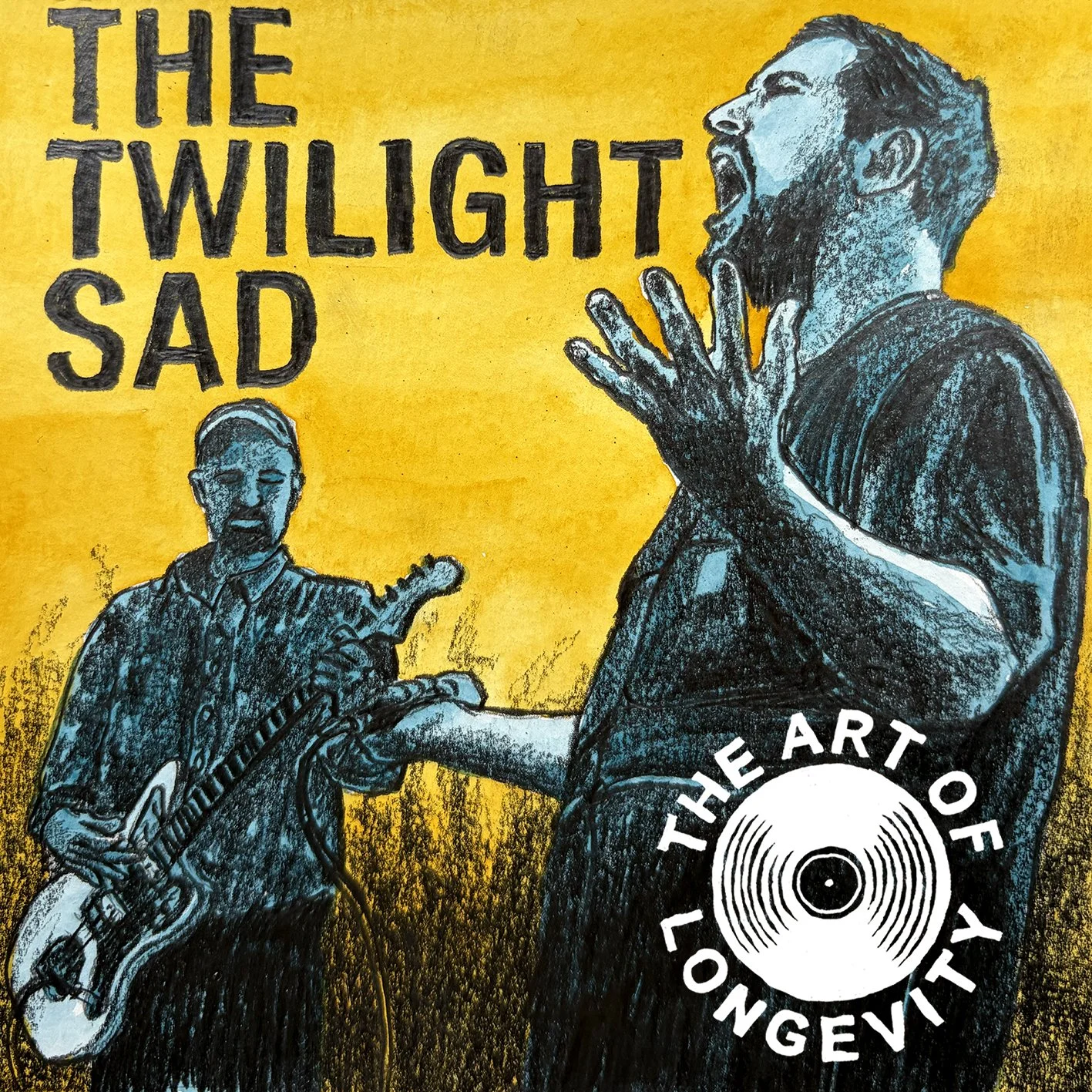
Season 13, Ep. 4: The Twilight Sad, on Finding Hope in all the Noise
After seven years between records, The Twilight Sad have returned with It’s the Long Goodbye, an album forged through grief, survival and renewal. Was it all worth it? Well, listen for yourselves. And do keep in mind that the album ranks 4th so far on the Album of the Year website’s 2026 best-of rankings. Not that we advocate music as a competition. Just saying, some albums are clearly worth the work.
On this episode of The Art of Longevity Podcast, vocalist James Graham and guitarist Andy MacFarlane reflect on the emotional weight behind the record, the realities of touring in modern music, and how the band have managed to stay creatively vital two decades into their career. And, not that they would ever mention it themselves, it’s a known fact that we are talking about Robert Smith’s favourite band here. On the band’s Spotify profile is Robert’s testimony: “They are the best band playing the best songs – consistently brilliant, emotional, intense, inspiring, entertaining.”
Now, who is going to argue with Robert Smith then, a?
The Scottish band’s sixth album arrived after what Graham describes as an intensely difficult period, shaped by personal loss and the long emotional aftermath of caring for his mother through Alzheimer’s disease. Yet despite the darkness surrounding its themes, there is a sense of optimism running through both the music and the band themselves. It transpires this is their most uplifting and dare we say, accessible record to date. And it may well be their best (not that we advocate a band should always compete with itself).
Our occasional co-host Mr David Freer spoke to the band before their sold out spine tingling show at London’s Roundhouse (add in Mick Clarke on pencil & paint and we have a all Scottish line up for this episode, although there is remarkably little swearing).
Clearly after tough times, The Twilight Sad are bringing their A game to the stage. Crucially, they are enjoying themselves while going about it.
“People are paying money to see us, and I’ve got to make sure I can sing properly and look after myself mentally and physically,” Graham explains while discussing the current tour. “In doing that, I’ve actually managed to enjoy it more than when I was out getting smashed all the time.” Graham admits that touring had once been fuelled by anxiety and alcohol, but age and experience have enabled him to shift his habits.
The band were speaking midway through a hectic touring schedule that followed the album’s release in March. After years spent making the record, the transition into rehearsals, in-store performances and a full European and UK tour felt almost surreal.
“The travelling’s hard, the sleeping in different beds, just moving around,” he said. “But that one hour and a half on stage, that’s the time that you’re meant to enjoy it. I’m enjoying that more than anything now.”
MacFarlane adds that the band’s live approach has always been about reinterpretation rather than replication:
“We’ve always tried to make the live show a bit different from the recorded album,” he explained. “But now it’s just a lot of practice and getting out and playing gigs. It eventually comes together.”
The Twilight Sad’s music has proved remarkably adaptable over the years, whether performed as a loud four-piece, stripped back acoustic, or accompanied by a full orchestra. One of the standout moments in the band’s history came during a performance at Paisley Abbey with the Royal Scottish National Orchestra — a show that Graham described as “one of the most stressful afternoons of our life.” Despite just a single hour of rehearsal with nearly 100 orchestral players, the result became one of the band’s most celebrated performances.
The emotional core of It’s the Long Goodbye centres on Alzheimer’s and the way music can preserve memory even as other parts of life disappear. Graham spoke movingly about the response the album has received from listeners dealing with similar experiences. For Graham, the experience reinforced the unique emotional power of music: “It’s the proof that music can unlock something that’s still there.”
The interview also touches on the darker realities of life within the music industry. Both musicians were candid about the lack of meaningful mental health support available to artists and bands.
“As far as the industry goes, nah,” Graham said when asked if support systems existed. “It’s way behind. You’re still turning up to venues and there’s full fridges of beer at 12 o’clock in the afternoon.”
MacFarlane is equally blunt about the wider challenges facing musicians in the UK.
“The UK is just completely different,” he said. “They’re not focused on the arts at all in comparison to Europe.” SOMEBODY SHOUT THAT LOUD!
Navigating the mangle of this wonderful and wicked business of music, the band continue to apply a fiercely independent philosophy. Reflecting on the principles that have guided The Twilight Sad since their beginnings, MacFarlane says the band had always tried to avoid chasing trends.
“We definitely knew who we didn’t want to be,” he explained. “We’d go watch gigs to learn what not to do rather than steal ideas.”
Among the band’s self-imposed rules: no encores. Graham:
“We play for an hour and a half, and that’s what we’re allocated for these venues. “We could go off and come back on and play two less songs, but we play extra songs instead.”
That refusal to conform has become central to The Twilight Sad’s identity. Their songs rarely follow traditional structures, instead unfolding more like emotional narratives than standard verse-chorus compositions. MacFarlane compares the process to deliberately pulling the rug from under the listener.
“You get something that sounds familiar to people,” he explains, “and then when they’re about to guess what happens, just go somewhere else.”
After twenty years together, it is the balance of emotional honesty combined with creative unpredictability that continues to drive The Twilight Sad on. Even in conversation, the bond between Graham and MacFarlane feels inseparable: two lifelong collaborators still pushing each other forward.
“I’m just a guy that writes music with his friend and goes and plays some gigs,” Graham said. “I want to simplify it to that point.”
For a band whose music often explores grief, anxiety and isolation, there remains something profoundly hopeful in that simplicity.
The Twilight Sad have a superb Bandcamp profile and you can buy their catalogue right there.