Steven Wilson might just be the busiest man in progressive music. Or he may be the most progressive man in music. Or just the busiest man in music. Band leader, solo artist, multi-instrumentalist, composer, producer, mixer and champion of immersive audio – Wilson has accumulated more musical identities than most artists have albums (he’s on solo album #9 himself). And yet, as he explains in this episode of The Art of Longevity, there's a remarkably simple thread connecting them all: an obsession with making records that sound, feel and mean something. And it didn’t start with The Beatles…
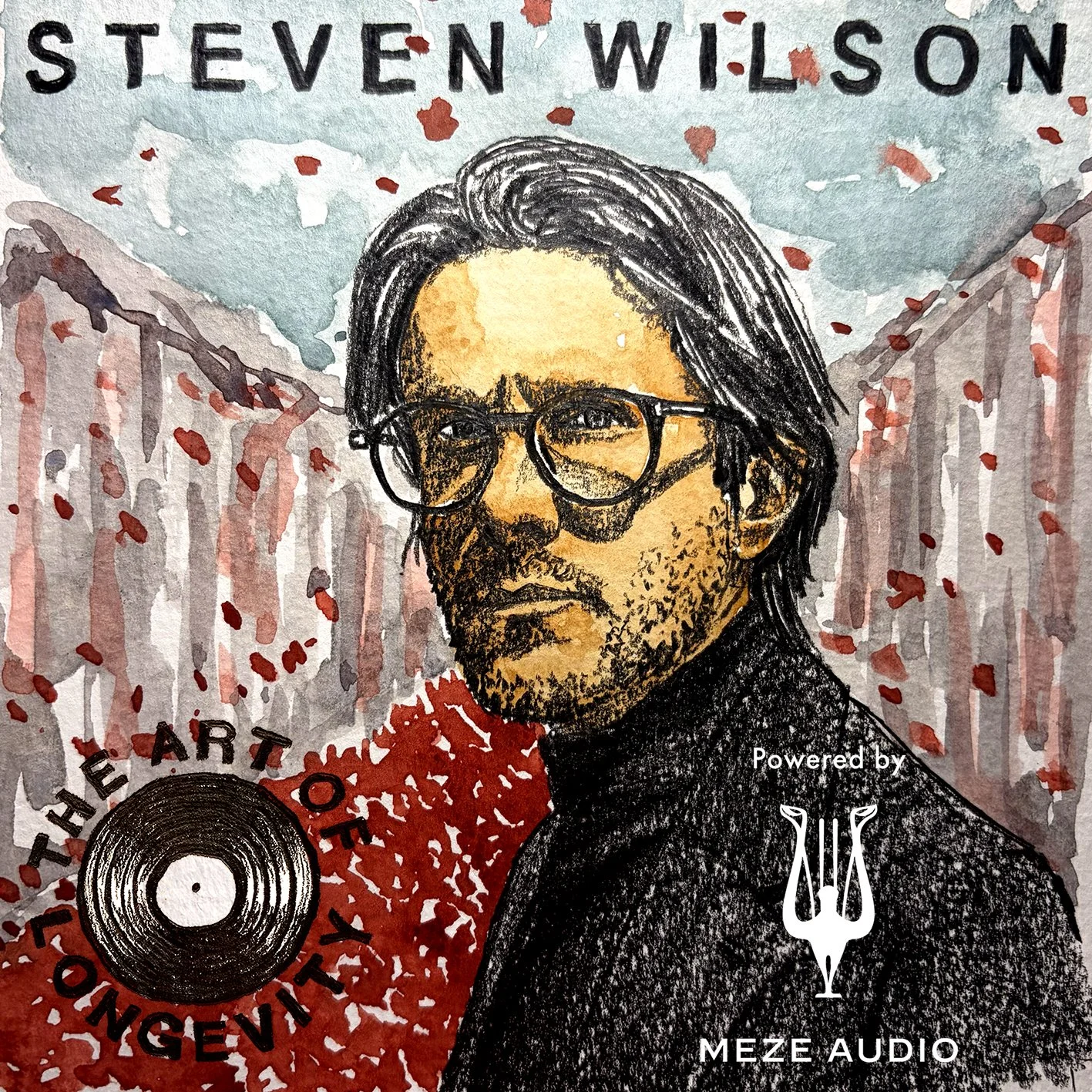
Cover by Mick Clarke
Season 14, Ep. 2: The Art of Never Standing Still, with steven wilson.
Steven Wilson's musical DNA was assembled at home. His father played Pink Floyd's Dark Side of the Moon and Mike Oldfield's Tubular Bells, while his mother supplied the disco grooves of Donna Summer, Giorgio Moroder and Chic. It's an unlikely but rather brilliant combination: conceptual ambition on one side, hypnotic rhythm on the other. Then came ELO's Out of the Blue, and the revelation of Jeff Lynne as the auteur behind the whole operation. Wilson was hooked:
“Jeff Lynne did everything. He was an auteur. He was a producer before I knew what a producer was. He wrote all the lyrics. I wanted to be that guy – the person responsible for creating an entire sonic universe and putting you, the listener, in that environment”.
That ambition led to two parallel projects in his twenties: No-Man (with Tim Bowness) and Porcupine Tree, initially a personal exploration of the progressive and psychedelic music that punk had seemingly obliterated from the music scene. Wilson assumed nobody else would be interested but he was wrong: instead, a thriving underground cassette-trading audience soon proved to be the kernel of what has now grown into a sizeable fan base – every one of them let’s say at the very least, deeply enthusiastic, about his work.
So much for being out of step, Wilson was simply tapping into a somewhat supressed love for that 70s behemoth of progressive rock. His career subsequently expanded in several directions. Porcupine Tree became a modern progressive rock institution, while his solo career developed into an extraordinary collection of contrasting musical expressions. As a producer and mixer, Wilson became one of the most trusted custodians of immersive/surround sound classic rock recordings, including albums by artists including Tears for Fears, Genesis, Yes and Pink Floyd.
“I don’t mean to sound like a cliché but the studio is my primary instrument”.
A telling admission from someone who can play guitar, keyboards and just about anything else he needs to have on a recording. Wilson’s work in surround sound and Dolby Atmos has become another distinctive calling card. But there's serious craft behind the technical wizardry. When reconstructing an old recording for an immersive mix, Wilson often spends 80% of his time recreating the original stereo mix before even beginning to move sounds around the room. It's less a case of adding bells and whistles than carefully understanding what made the original recording such magic in the first place.
That immersive philosophy feeds directly into his own music, including his latest solo album, Requiem For A Village. Conceived around an imagined community existing before the internet, social media and AI, the album is an exercise in atmosphere, nostalgia and deliberate imperfection. Wilson banned digital instruments, embraced analogue sounds, played instruments he couldn't properly play (including violin and oboe), and resisted the modern studio temptation to fix every misplaced note. In other words, he deliberately made life difficult for himself. The results are apparently all the better for it.
“I came into the business just after the analogue era. What’s magical about older records is that the drumming wasn’t even on a click track and the drummer would speed up by accident. I found that exciting. So, for Requiem for a Village, the concept was nostalgic in that way: embracing mistakes, adding brush strokes, time changes and imperfections – capturing that magic. And that is hard to do in the 21st Century because it’s so easy to fix things”.
So, with such a varied polymathic music career up to this point, what has Wilson learned about his own longevity?
“It’s about intent. One of the problems – challenges – about longevity is fan expectations. Every listener I have, has found me through a certain [musical] door – and as fans or listeners we all want our favourite artists to keep making that music. As the artist, you must arrogantly believe you can confront the expectations of your audience, and they are going to love it anyway…winning them over”.
Wilson’s go to examples here are Bowie and Peter Gabriel: artists who kept changing, surprising and occasionally challenging their audiences. And yet that is counter to how the music industry encourages artists to work. When albums arrive five or ten years apart, the stakes become enormous and experimentation becomes harder.
Despite Wilson’s house containing no Beatles records and his own work much more influenced from elsewhere, he’s constantly reminding people that The Beatles produced their entire output in just eight years! With today’s artists sometimes taking that long to make another album, the stakes are too high for that kind of zig-zag career of creative left & right turns.
Wilson, thankfully, shows no signs of slowing down. He rarely takes a day off, still collects records by the dozen and considers remixing Pink Floyd's Live at Pompeii or Tears for Fears' The Seeds of Love a privilege rather than a job.
His secret? Never confuse a successful career with a finished creative journey. Keep making things, keep learning, and above all, never make the same record twice.
Bowie would be proud and probably, a fan to boot.
Requiem for a Village is out now on Fiction.
Mick Clarke’s portrait for the cover of this episode drops Steven into the village graveyard from the album’s cover artwork.