Gilbert O’Sullivan is celebrating sixty years in music. Since releasing his first tracks in 1967 he has made a bunch of classic songs that will last forever, and some 21 studio albums, the latest being On The Record. But what keeps him going? It’s all about the songs - and that means new songs: “I love the craft - that’s what provides me with the feeling of being good in the present and looking forward to the future. I don’t dwell on the past although I’m proud of what happened. But I’m in a good place and that’s all down to the songs”. Keith talks to Gilbert as his celebration takes to the road.
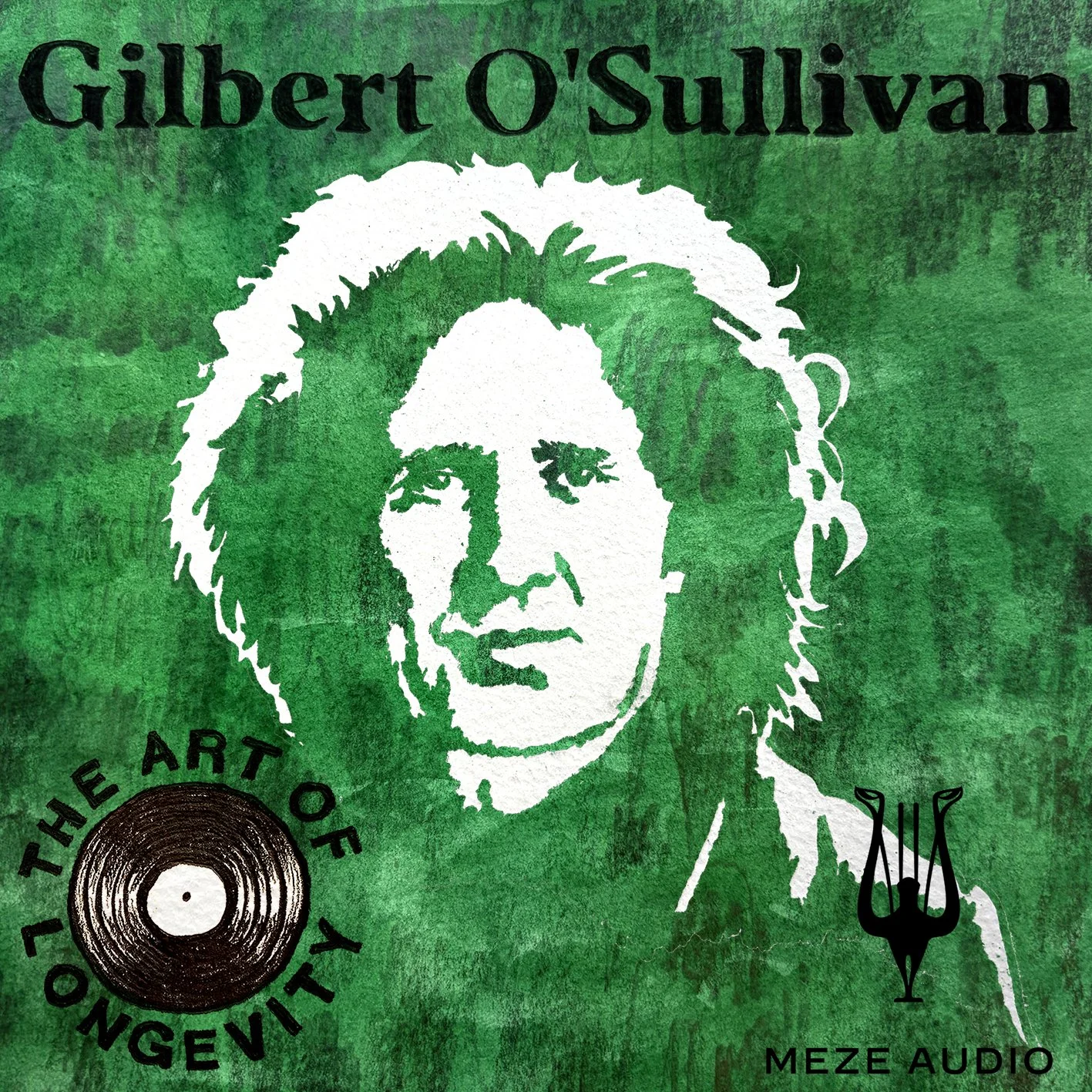
Cover by Mick Clarke
Season 14, Ep. 1: gilbert o’sullivan keeps adding to the jukebox.
Since releasing his first tracks in 1967, Gilbert O’Sullivan has achieved 16 UK Top 40 songs and made 21 studio albums. His breakthrough was in 1970 with Nothing Rhymed, followed by classics such as Clair, Get Down and Matrimony. His biggest song, the deeply sad but still bouncy ballad Alone Again (Naturally) is fast approaching 340 million Spotify streams. Not too bad for a song whose first verse features the protagonist ‘treating himself’ to a suicide mission. When O’Sullivan performs the song live, he invites the audience to sing along to the verses as well as the chorus, and so the crowd cheerfully sing about throwing themselves off the top of a nearby tower. If that doesn’t sum up songwriting genius I don’t know what does.
60 years as a pro also makes O’Sullivan the most longevous guest so far on the Art of Longevity podcast. Nile Rogers isn’t too far behind (only a mere decade), and then comes Gary Numan (1978). Unless I can persuade Macca or Mick Jagger to come on (don’t bet against it) no guest is likely to go further back in the musical time machine. And yet Gilbert is churning out new music at the same rate as someone in their first decade, almost. The new album On The Record is a brand new set of original songs that comes off the back of two other recent L.P.s, 2022’s Driven and 2018’s self-titled album (often referred to by O’Sullivan as “the Ethan Johns record” after its erstwhile producer*).
Not only that, but these records are as good as anything in his now extensive body of work. So how come O’Sullivan is on a roll when he might easily have downed tools or just played live “jukebox” shows like Bill Joel does (or indeed his contemporary British counterparts Leo Sayer and David Essex - both of which come up in this conversation as currently touring their old songs)?
What has longevity brought to O’Sullivan?
“Mostly it's the songwriting. Everything revolves around the songs. I don’t know what else I would be doing. I’ve been writing songs since I was 15 years old and it’s almost second nature to me now. I love the craft - that’s what provides me with the feeling of being good in the present and looking forward to the future. I don’t dwell on the past although I’m proud of what happened. But I’m in a good place and that’s all down to the songs”.
He’s definitely made a few belters on this new record. Opening track “It’s Me” bounces along like Steely Dan, but that voice and lyrics can only be Gilbert O’Sullivan. After 60 years nobody sounds like him. He follows it with “I Suppose”, a song that comes off like one of his 70s singles. The album’s lead single is the wistful ballad “Growing Old Disgracefully” which he wrote in a hurry, convinced that one of his peers would come up with the same title and get it out before he had the chance. It also comes across well as a t-shirt slogan on the tour (“we sold 52 of them at the first show” he tells me, impressively on top of his merch operation).
Any album that’s got three good songs at the start is already doing well, but a little deeper in we get the more introspective “I Must Be Going” - a great song and one of those album centrepiece tracks with real depth - including superb guitar work by Gilbert’s right hand man of the past few years, Bill Shanley. Later on the record, “Wait” sounds like another mid-70s hit single, while the closer “See Us Gone” employs a male voice choir and harks back to his “comeback” album of 1994 (and a big favourite of my own) Every Song Has Its Play. It’s been good fun revisiting Gilbert’s catalogue in preparation for the conversation and reading some old reviews. This one from Record Collector on (2nd album Back to Front, 1972) really caught my eye:
“Back To Front is rammed with diffident, bashful, playful greatness, from the assonant convolution and linguistic legerdemain of The Golden Rule to the could-the- world-ever-have-been-like-this innocence of Clair – a song that, as O’Sullivan ponders in the sleevenotes, probably couldn’t be written in a century as cynical and suspicious as this one”.
If we thought the last century was cynical and suspicious in 1972 then consider what we have now, but if you replace the song titles, that review could well apply word-for-wordy-word, to On The Record.
While O’Sullivan is focused on progress, there is a feeling that this new album revisits his 70s heyday, and there wouldn’t be anything wrong with that. When I ask about his own favourites from the catalogue, he actually chooses two I missed out revisiting; his self-produced fifth album Southpaw (1977, with the great Chris Spedding on guitar) and the more recent Latin ala G! (2015, inspired by Peggy Lee’s sojourn into Latin music and produced by Peter Walsh). Both qualify as lost gems. As Gilbert says, these albums are “there, merely resting” and available for requests from fans at any time, which he is happy to oblige occasionally by placing deep cuts into his live sets. I see this in action during his recent London Palladium show (the tour finale) for which the setlist was nothing if not eclectic and yet huge fun, smattering his 60 year journey across a full two hours).
Back to the present, the accompanying press release says “his vision has never wavered in more than half a century”. I challenge Gilbert on this, which surely can’t be true. Every artist travelling as long and far through a career in music must have had extended periods of doubt or even despair. O’Sullivan’s career has been subject to a few episodes of contractual and legal difficulties including a five-year pause on recording/releasing new material in the 1980s due to a bitter legal dispute and contractual battle with his former manager. Was there a moment he thought the game was up?
“Oh no I would never have thought like that. I was down in some moments but it would be over in a day and the next day I would be fine, whatever the criticism. I had problems with my image. Nobody liked how I looked, but I was still proud of my image and determined to use it”.
It may well be true then. After an hour in Gilbert’s company I’m left with the impression of someone whose self-belief has never really been shaken that much, even by classic music industry hazards such as overwork, rough press, criticism over image/looks, fallouts and lawsuits and long spells in the cold, commercially speaking. Through it all, he’s focused on the songs and keeping his voice in shape, remaining refreshingly sane and optimistic.
Both as we chat and then again at the Palladium on the tour finale, O’Sullivan mentions his gratitude at still being able to put records out (specifically crediting his current label BMG), even when he might expect to sell just a few - perhaps even fewer than those Growing Old Disgracefully t-shirts.
Seems to me that Gilbert O’Sullivan is true to his word apart from one thing - he himself is growing old rather gracefully.
* That’s the last two episodes in which Ethan Johns features, but the producer’s name has come up multiple times on The Art of Longevity. Perhaps it’s time to have Ethan on in some capacity.
On the Record is out now on BMG.
Mick Clarke’s portrait for the cover of this episode takes Gilbert as he is now, with a background colour wash nodding to Gilbert’s third album I’m a Writer Not a Fighter, an iconic album cover that still finds its way onto Gilbert’s merch items today.