Kevin Drew is with us, representing Broken Social Scene. And Drew is taking no prisoners. He doesn’t want to talk about A.I. or negative Daisy Jones & The Six bullshit. Good neither to we. Pleasantries out of the way, we get down to the business of getting beyond the cliches.
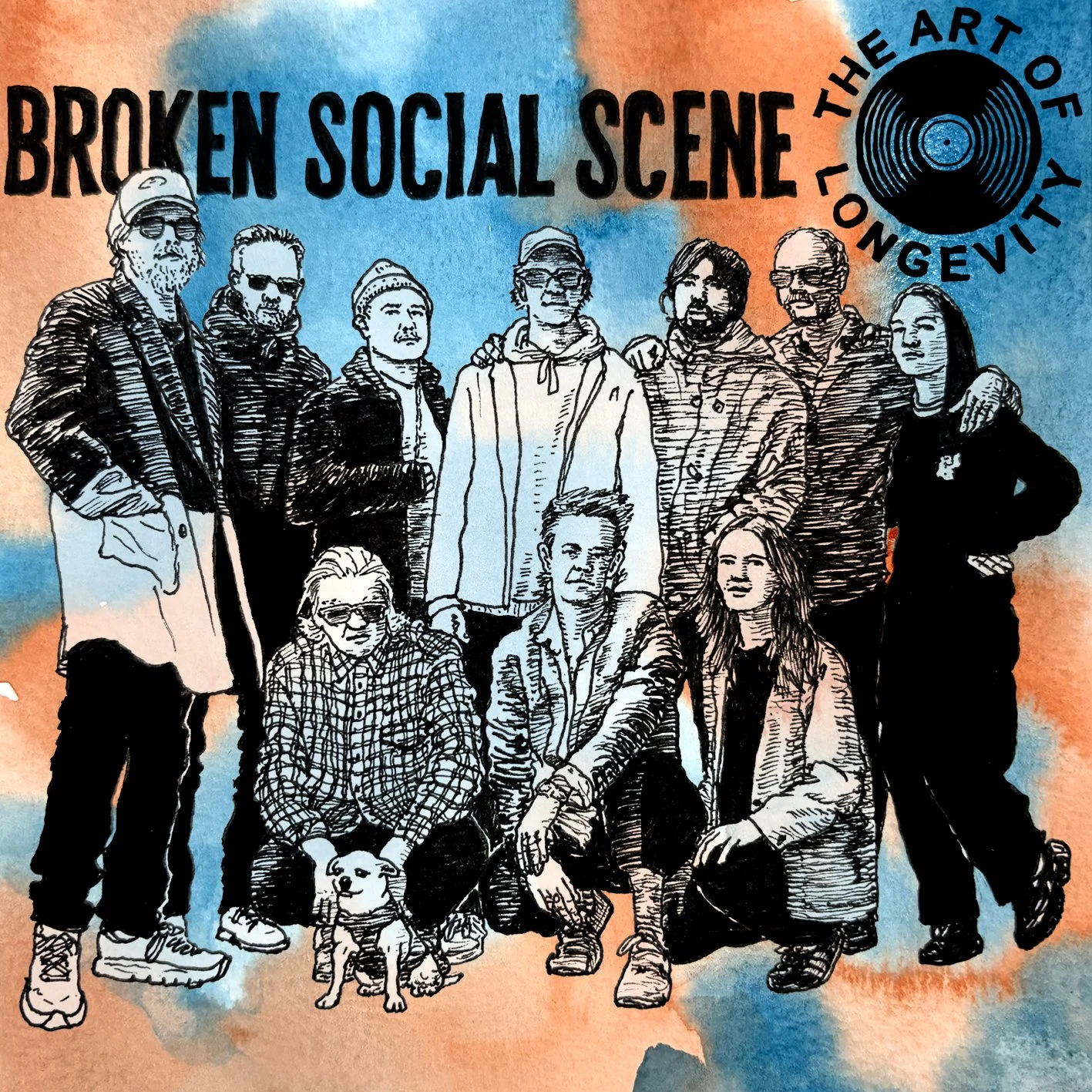
Season 13, Ep. 5: broken social scene are done with the cliches
There’s a point in every long music career where survival becomes more interesting than success. Not survival in the purely commercial sense. Not chart positions, algorithmic reach or streaming milestones. But survival of identity. Survival of friendship. Survival of purpose. The good stuff that can easily get buried away in the cut & thrust of a fickle business like music.
That’s where Kevin Drew of Broken Social Scene finds himself now, nearly 25 years after the collective first emerged from Toronto’s indie underground and quietly became one of the defining musical communities of the 2000s. Drew is thoughtful, funny, open & revealing; and utterly uninterested in rock mythology. There are no grand narratives about being an artist in the world of “rock & roll”. In fact, he vehemently rejects them.
“I can’t handle any more Daisy Jones & The Six bullshit. It’s all drugs, drugs, drugs. The road’s about constipation, man. It’s not about partying. It’s about how my metabolism works on the road but nobody wants to make that movie.”
The refusal to romanticise the cliché is central to Broken Social Scene’s longevity. And that’s what we love about The Art of Longevity. In fact I’m going to call it “getting beyond the cliches of being an artist in the modern music business”. While many bands implode under the pressure of ego, success or repetition, Drew talks about music instead as community: the messy, imperfect, emotional humanity of it.
“Our success is not of an individual. It's a group of people. We’re in this together. We’re still going. Some of us have more success than others. Some people have swimming pools, some of us are renting. We have great lives, we have great kids, we have success, because success is honesty”.
That philosophy runs through Remember the Humans, the band’s first album in nine years. It’s a record shaped not by urgency or any loud “comeback” ambition, but by reflection. The album opens with a trio of mid-tempo songs, thereby breaking every rule there is in the modern biz. Except the three songs are just great, and set the listener up for a journey that ebbs & flows like all good albums do.
A collective is a very different beast from a band. For the various rotating members of Broken Social Scene (some 26 that I could count), life and careers intersect in a spaghetti junction of a band dynamic. Relationships have changed. Parents have died. Careers have diverged. Some members of the collective found more commercial success (Feist) and others, cult success of their own (Metric, Stars). Others have remained on the industry boundaries, let's say. In many ways, Broken Social Scene’s collective structure became the mechanism for survival - swerving the dysfunctional family syndrome or the stagnation that destroys so many traditional ‘working bands’.
“What is our success with the band is also what holds us back,” Drew admits. “There’s a lot of us. Everyone has opinions.”
And in the modern way of the cult band, the Quiet Legend of surviving and thriving without the affirmation of industry success metrics, the collective extends further than the members of Broken Social Scene on the stage:
“It really took a village,” he says. “Our partners, our crew, our friends, the audience. Broken Social Scene’s success is everyone over the last 26 years deciding they want this.”
But don’t all “pop stars” need a little buzz of affirmation at some stage?
“I drank that,” Drew says of jealousy and frustration. “I went off and tried solo stuff. I can’t say I wasn’t mad at other people’s success at times.”
But age changes perspective. For Drew, longevity isn’t about reinvention or relevance. It’s about remaining open to collaboration, to vulnerability, to change, to people.
“This is our reaction to denial. It’s our reaction to what’s going on. People are hurting. They are suffering right next to us. Our music is trying to help you be safe. “You get there,” he says. “You just go, no, I gotta know what I have.”
Far from broken, this way of operating seems to be working just fine.
Buy Broken Social Scene’s music on Bandcamp.